Algorithms That Scale
Master searching, sorting, graph algorithms, and Big O analysis, and prove exactly why one approach beats another.
Computer Science (B.S.)
How does a search engine find the right answer out of billions in a split second? How does your phone recognize your face in a blink? Computer Science shows you how, then teaches you to build it yourself.


Is This You?
You do not need to be a genius or a lifelong coder. You need curiosity and the grit to stay with a hard problem until it finally clicks. That moment is addictive.
What You Will Build
Anyone can make code run. Computer scientists make it fast, make it smart, and prove it is right.
Master searching, sorting, graph algorithms, and Big O analysis, and prove exactly why one approach beats another.
Write multithreaded, parallel code that splits huge jobs across many processors, the same way streaming services, search engines, and large-scale data systems work.
Wrangle real data with Python and SQL, find the patterns hiding in it, and build, train, and evaluate machine learning models.
Hash tables, trees, graphs, and design patterns: Organize information so a program stays fast whether it serves ten users or ten million.
Gather requirements, design the interface, write and review code, test, and deploy a product together, exactly the way professional software teams do.
Pick advanced topics in your final year and go deep in the area that excites you most.
Try It
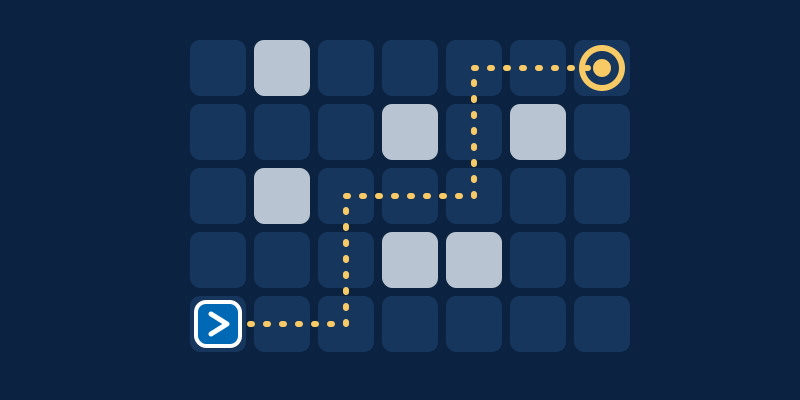
Guide a robot through a maze, then watch a search algorithm find the shortest path square by square. It is the same idea you will master in CSE 381 Algorithms & Complexity.
Play Robot Path PuzzlesYour Path
Pick your degree and see the core courses you will take. Your advisor helps you shape the rest.
This is one suggested sequence. Review other course-plan options and flowcharts, then tailor a specific plan with an advisor today.
How You Will Learn
You learn programming from the ground up, so you can read any codebase, debug it, reverse engineer how it works, and tell the moment something is wrong. You also study how intelligent systems are built: How they work, where they fail, and how to build them responsibly. Then you use them as one tool among many.
Most courses ask you to explain your thinking, test your work, and build with others. Those are exactly the habits employers and graduate schools look for, and they are what make you hard to replace.
Where It Can Lead
Computer Science graduates step into software engineering roles or continue on to graduate school.
Reported average earnings for BYU-Idaho Computer Science graduates, from federal Post-Secondary Employment Outcomes (PSEO) data as published on the Computer Science major page. Starting salary means earnings in the first year after graduation. Earnings vary and are not a guarantee.
Already a Student?
Plenty of great engineers found computing a little later. Here is how to jump in without losing momentum.
Take CSE 110 Introduction to Programming. It is the first course in both majors and the fastest way to find out if you love this. Already programming? Test out with the LUC placement test and start in CSE 111.
An advisor can show how your current credits fit and map out your semesters. Meet with Academic Advising.
See how courses from another school may count with the course transfer tool. Official evaluation decides what applies.
Whether you served a mission, worked, or cared for family, there is a path back. Former student admission.
Current students can also use the Student Hub for tools built for BYU-Idaho students. Questions about computing? Contact the CSE Advising Office at STEMadvising@byui.edu or 208-496-9880.
Your Next Step
Apply to BYU-Idaho and write your first program in CSE 110 your very first semester.